How People Are Using AI for Stock Analysis — And What It Means for Every Indian Investor
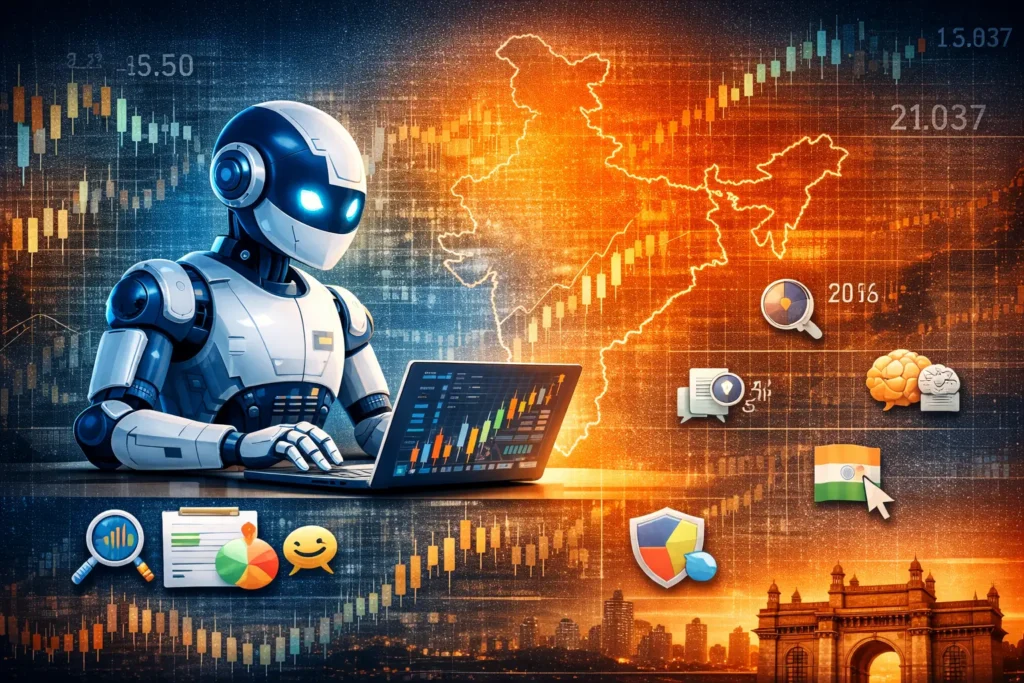
Something is changing in the world of investing — and most retail investors in India have not noticed it yet.
The tools that were once available only to the largest hedge funds and institutional investors on Wall Street are quietly becoming accessible to anyone with a smartphone and an internet connection.
Artificial intelligence is reshaping stock analysis. Not in the distant future. Right now. Today.
From screening thousands of stocks in seconds to reading company annual reports in minutes, from detecting accounting fraud patterns to predicting short-term price movements — AI is being used across every layer of the investment process.
The question is not whether AI will change investing. It already has. The real question is — are you using it, or are you being left behind by those who are?
1. Screening Thousands of Stocks in Seconds
The Indian stock market has over 5,000 listed companies. No human investor can meaningfully analyse all of them. For decades, this created an enormous advantage for large institutional investors who had teams of analysts doing nothing but scanning the market for opportunities.
AI has completely changed this dynamic.
Today, retail investors are using AI-powered stock screeners that go far beyond simple filters like P/E ratio or market cap. These tools use machine learning algorithms to scan thousands of stocks simultaneously — looking for complex combinations of financial metrics, technical patterns, and qualitative signals that would take a human analyst weeks to process manually.
Tools like Screener.in, Trendlyne, and global platforms like Trade Ideas use varying degrees of AI to help investors find stocks that match highly specific criteria — consistent revenue growth, improving return on equity, low debt, high promoter holding, and dozens of other parameters — all in seconds.
What this means for you: The era of missing a great stock simply because you did not have time to find it is ending. AI screeners level the playing field significantly for retail investors willing to learn how to use them.
2. Reading and Analysing Annual Reports
Annual reports are goldmines of information — but they are also long, dense, and deliberately written in language that can obscure as much as it reveals.
A typical Indian company’s annual report runs anywhere from 100 to 400 pages. Reading it thoroughly, extracting the key insights, cross-referencing the financial statements, and identifying potential red flags would take an experienced analyst an entire day — sometimes longer.
AI tools are now doing this in minutes.
Investors are feeding entire annual reports into large language model tools — AI systems capable of reading, understanding, and summarising complex documents. They are asking these tools specific questions:
- “Has the company’s debt increased significantly in the last three years?”
- “What risks did management highlight in this year’s report that were not mentioned last year?”
- “How has the company’s explanation for its performance changed compared to last year’s annual report?”
- “Are there any unusual related party transactions mentioned in the notes to accounts?”
The AI reads the entire document and provides clear, structured answers in seconds. What used to require hours of careful reading can now be done in a fraction of the time — with the AI flagging sections that deserve closer human attention.
What this means for you: You no longer have an excuse to skip annual reports. AI makes them accessible to every investor — not just professionals with hours to spare.
3. Sentiment Analysis — Reading the Market’s Mood
Stock prices are driven by two things: fundamentals and sentiment. Most retail investors understand fundamentals — earnings, revenue, debt. Very few understand how to measure and use sentiment systematically.
AI has made sentiment analysis a practical tool for everyday investors.
AI-powered sentiment analysis tools scan thousands of data sources simultaneously — financial news articles, company press releases, social media discussions, analyst reports, earnings call transcripts, and even regulatory filings — and generate a real-time sentiment score for individual stocks or the broader market.
If a company’s management is consistently using cautious or negative language in quarterly earnings calls — even while reporting positive numbers — AI sentiment tools can detect this shift before the market reacts. If social media discussion around a stock is turning increasingly negative, sentiment analysis can quantify that trend long before it shows up in the share price.
Hedge funds and institutional investors have been using sophisticated versions of these tools for years. Retail-friendly versions are now available through platforms that Indian investors can access directly.
What this means for you: Understanding market mood is no longer guesswork. AI gives you a structured, data-driven way to measure sentiment — one of the most powerful and underused inputs in investment decision-making.
4. Technical Analysis — Pattern Recognition at Scale
Technical analysis has always been about pattern recognition. Human traders spend years learning to identify chart patterns — head and shoulders, double bottoms, cup and handle formations, support and resistance levels, moving average crossovers.
AI does this faster, more accurately, and across thousands of charts simultaneously.
Machine learning algorithms have been trained on decades of historical price and volume data. They can identify technical patterns with a precision and speed that no human trader can match — and they can do it across the entire NSE and BSE universe at once, flagging stocks that are approaching key technical levels or forming high-probability setups.
Beyond pattern recognition, AI is being used for:
Algorithmic Trading Large institutions and increasingly sophisticated retail traders are using AI-driven algorithms that execute trades automatically based on pre-defined technical and fundamental criteria — removing human emotion from the execution process entirely.
Price Prediction Models While no AI can predict stock prices with certainty — and anyone claiming otherwise is misleading you — machine learning models trained on vast historical datasets can identify probabilistic patterns that suggest higher or lower likelihood of near-term price movements. These are tools for probability assessment, not crystal balls.
Volatility Forecasting AI models are used to forecast periods of likely high volatility — useful for options traders managing risk and for long-term investors deciding when to add to positions.
5. Detecting Accounting Fraud and Financial Red Flags
This is perhaps the most powerful and underappreciated application of AI in stock analysis — and it has direct, urgent relevance for Indian retail investors.
India’s stock market history is unfortunately dotted with accounting frauds and financial manipulation. From Satyam to IL&FS to dozens of smaller listed companies — investors have lost thousands of crores because manipulated financial statements were not detected in time.
AI is changing this.
Machine learning models trained on historical cases of accounting fraud can now scan a company’s financial statements and detect statistical anomalies that suggest possible manipulation — things that are virtually impossible for a human analyst to spot without months of forensic investigation.
These models look for patterns like:
- Revenue growing much faster than cash collections — a classic sign of revenue inflation
- Receivables increasing disproportionately to sales growth
- Unusually high and growing “other expenses” categories
- Cash flow from operations consistently lower than reported net profit
- Sudden changes in accounting policies buried in notes to accounts
- Related party transactions that do not make commercial sense
Tools using variations of the Beneish M-Score — a statistical model for detecting earnings manipulation — are being enhanced with machine learning to become significantly more accurate and nuanced than the original formula.
For Indian retail investors who have been burned by fraudulent companies in the past, AI-powered fraud detection is not just useful — it is potentially wealth-saving.
6. Personalised Portfolio Analysis and Risk Assessment
Beyond individual stock analysis, AI is being used to analyse entire portfolios — giving investors insights that previously required a professional financial advisor.
Investors are using AI tools to:
Analyse Portfolio Concentration Risk Is your portfolio dangerously overexposed to one sector, one theme, or one type of business? AI can quantify this risk and suggest rebalancing strategies tailored to your specific holdings.
Stress Test Portfolios What would happen to your portfolio if interest rates rose sharply? What if the rupee weakened significantly against the dollar? What if oil prices doubled? AI models can run these scenarios across your actual holdings and show you the likely impact — helping you understand and manage risk before it materialises.
Identify Correlation Between Holdings Many investors think they are diversified when they actually own multiple stocks that move together. AI can identify hidden correlations in your portfolio — for example, showing you that five of your ten stocks are all heavily exposed to the same underlying economic factor.
Track Portfolio Health Over Time AI tools can monitor your holdings continuously, alerting you when a company’s financial metrics deteriorate, when management makes a significant statement, or when technical levels are breached — so you are never caught off guard by developments in your own portfolio.
7. Earnings Call Analysis — What Management Is Really Saying
Every quarter, listed Indian companies hold earnings calls where management discusses results and takes questions from analysts. These calls contain enormous amounts of information — but also enormous amounts of corporate spin, carefully crafted language, and deliberate vagueness.
AI is helping investors cut through the noise.
Tools are being used to transcribe earnings calls in real time and then analyse the language used by management across multiple dimensions:
Confidence and Certainty Levels Is management speaking with confidence about future growth, or are they hedging every statement with qualifications? A shift from confident to cautious language — even when the numbers still look good — can be an early warning signal.
Consistency With Previous Calls Has management changed their explanation for a key metric without acknowledging the change? AI can compare language across multiple quarters and flag inconsistencies that human listeners might miss.
Response Quality to Analyst Questions When analysts ask difficult questions, does management answer directly or deflect? AI sentiment tools can score the quality and directness of management responses — giving investors another data point on management transparency.
The Limitations — What AI Cannot Do
Being honest about AI’s limitations is just as important as understanding its capabilities.
AI Cannot Predict the Future No matter how sophisticated the model, stock prices are influenced by countless unpredictable variables — geopolitical events, natural disasters, regulatory surprises, global pandemics. AI works with historical patterns. It cannot account for genuinely unprecedented events.
AI Can Amplify Bad Inputs Garbage in, garbage out. If an AI model is trained on incorrect or manipulated financial data — which is a real risk in markets where accounting fraud exists — its outputs will be flawed. AI is a powerful tool for analysis, not a replacement for human judgment and verification.
AI Does Not Understand Business Context A great AI model can tell you that a company’s revenue growth is slowing. It cannot tell you whether that slowdown is a temporary blip or a fundamental shift in competitive dynamics — at least not without significant human context and judgment layered on top.
AI Creates New Risks When large numbers of investors use the same AI tools and act on the same signals simultaneously, it can create new forms of market instability. If thousands of algorithmic systems all receive the same sell signal at the same moment, the resulting crash can be faster and more severe than anything driven by human decision-making alone.
How Indian Retail Investors Can Start Using AI Today
You do not need to be a data scientist or a programmer to start benefiting from AI in your investment process. Here are practical starting points:
For Stock Screening Start with Trendlyne or Screener.in for India-specific AI-enhanced screening. These platforms have free tiers that provide significant value.
For Annual Report Analysis Use Claude, ChatGPT, or Google Gemini. Upload or paste sections of annual reports and ask specific, detailed questions. The quality of insights you get will surprise you.
For Sentiment Analysis Follow FII and DII flow data daily on the NSE website. Use platforms like StockEdge that aggregate news sentiment for individual Indian stocks.
For Portfolio Analysis Tools like Smallcase and Kuvera provide portfolio analytics that incorporate elements of AI-driven risk assessment tailored to Indian investors.
For Learning Before using any AI tool for actual investment decisions — understand its methodology, its limitations, and how it generates its outputs. A tool you understand is far more valuable than a black box you blindly trust.
Final Thoughts
Artificial intelligence is not going to replace the need for human judgment in investing. The best investors of the next decade will not be the ones who outsource all their decisions to AI — they will be the ones who use AI as a powerful tool to enhance their own research, save time, identify opportunities they would otherwise miss, and manage risk more effectively.
The Indian retail investor who learns to combine solid fundamental understanding with the analytical power of AI will have a meaningful edge over the vast majority of market participants who are still making decisions based on tips, gut feeling, and surface-level research.
The tools are available. They are increasingly affordable. Many are free.
The only question is whether you will learn to use them — before everyone else does.
Disclaimer: This article is for educational and informational purposes only and does not constitute financial or investment advice. Mention of specific tools and platforms is for illustrative purposes only and does not constitute endorsement. Always conduct your own research before making investment decisions.