Small Cap Stocks That Became Large Caps — What They Had in Common
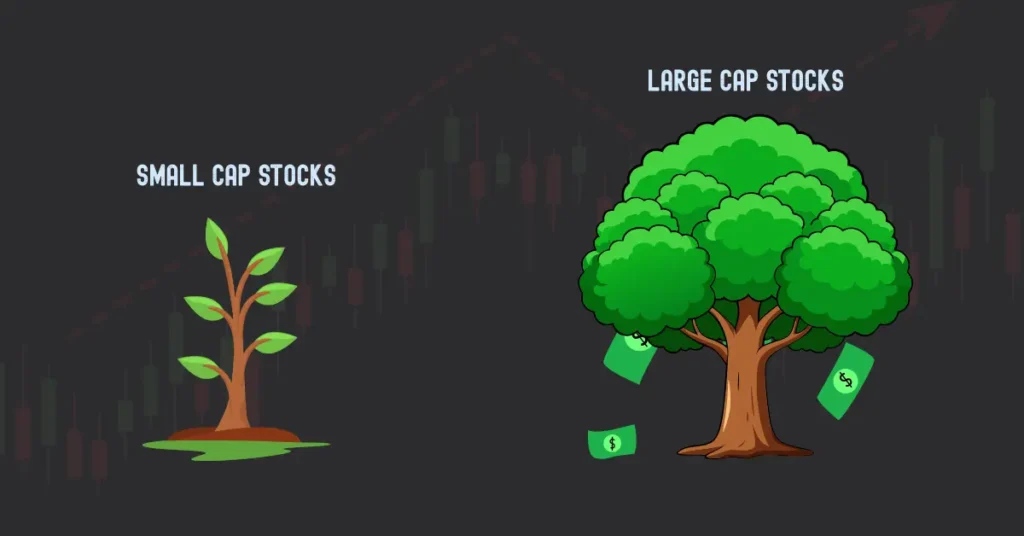
Every large cap stock in India was once a small cap.
Every giant company trading at thousands of rupees per share — the ones that have made investors wealthy beyond imagination — was once a tiny, overlooked business that most people had never heard of.
Titan Company. Bajaj Finance. Asian Paints. Page Industries. These are not just stock market success stories. They are blueprints. And blueprints can be studied, understood, and — with patience and discipline — replicated.
The question serious investors should be asking is not which small cap will become the next large cap. The more important question is — what did the ones that made it have in common?
That is exactly what this article answers.
First — Understanding the Journey
Before diving into the common traits, it helps to understand the scale of what we are talking about.
In India, stocks are classified by market capitalisation — the total value of all shares combined:
- Large Cap — Top 100 companies by market cap (typically above ₹20,000 crore)
- Mid Cap — Companies ranked 101 to 250
- Small Cap — Companies ranked 251 and below
For a small cap company to become a large cap, it typically needs to grow its market capitalisation by 10x, 20x, sometimes 50x or more over a period of years or decades. This kind of growth does not happen by accident. It follows a pattern — and that pattern has clear, identifiable characteristics.
1. They Operated in a Large and Growing Market
Every small cap that became a large cap was operating in a sector with massive runway for growth.
Think about Bajaj Finance in the early 2000s. Consumer lending in India was dramatically underpenetrated. Hundreds of millions of Indians had no access to formal credit. The market was not just large — it was enormous and almost entirely untapped.
Or consider Titan Company. When it entered the watch and jewellery market, India’s organised retail sector was tiny. Most jewellery was bought from local unbranded jewellers. The shift toward organised, branded retail was an unstoppable long-term trend — and Titan was perfectly positioned to capture it.
This is a pattern that repeats without exception. The companies that grew from small to large did not fight over a shrinking or stagnant pie. They found large, expanding markets and planted their flag early.
What to look for today: Sectors like electric vehicles, specialty chemicals, healthcare infrastructure, digital financial services, and defence manufacturing in India still have enormous room to grow. Small companies operating in these spaces with strong fundamentals deserve serious attention.
2. They Had a Durable Competitive Advantage — A Real Moat
A business can grow fast for a few years through aggressive marketing, cheap pricing, or favorable timing. But sustaining that growth for a decade or more requires something deeper — a genuine competitive moat that protects the business from rivals.
The small caps that became large caps almost always had at least one of these moats:
Brand Power Asian Paints built one of the most trusted consumer brands in India over decades. When a homeowner thinks about painting their house, Asian Paints is often the first and only name that comes to mind. That brand loyalty is extraordinarily difficult for any competitor to replicate — even with unlimited money.
Switching Costs Companies like HDFC Bank and Tata Consultancy Services (in their earlier, smaller days) benefited from high switching costs. Once a customer or business deeply integrates a product or service into their life or operations, leaving becomes painful and expensive. This creates sticky, recurring revenue.
Cost Advantage Some companies grew large by being the lowest-cost producer in their industry — making it nearly impossible for competitors to undercut them profitably. This is particularly common in manufacturing sectors like chemicals and textiles.
Network Effects A product or service that becomes more valuable as more people use it has a network effect moat. In India’s digital era, companies in payments, marketplaces, and platforms have benefited enormously from this dynamic.
The critical point: Without a moat, any business success is temporary. Competition will eventually erode margins, steal customers, and destroy shareholder value. The companies that went from small to large did so because their competitive advantage widened over time — not narrowed.
3. The Promoters Were Exceptional — Honest, Ambitious, and Capital-Efficient
If there is one single factor that separates great Indian small cap stories from disasters, it is promoter quality.
India’s market has seen countless small companies with good products and good markets fail — simply because the promoters were dishonest, incompetent, or used the listed company as a personal ATM rather than building a genuine business.
The companies that made it had promoters with three non-negotiable qualities:
Integrity They treated minority shareholders fairly. They did not dilute equity unnecessarily, did not engage in related party transactions that enriched themselves at the company’s expense, and communicated honestly with the market — even when the news was bad.
Long-Term Vision They were not trying to pump the stock price. They were trying to build a business. This distinction matters enormously. Promoters focused on business building reinvest profits intelligently, hire great talent, and make decisions with a 10-year horizon — not a 10-month one.
Capital Efficiency They understood that how you use money matters as much as how much money you make. The best promoters generated high Return on Equity (ROE) and Return on Capital Employed (ROCE) — meaning every rupee invested in the business generated strong returns. This compounding of capital is the engine behind every great small-to-large-cap journey.
How to assess promoter quality as a retail investor:
- Read the last 5 years of annual report letters to shareholders
- Check promoter shareholding trend — has it increased or decreased?
- Look at promoter pledging history
- Research the promoter’s track record in previous businesses
- Check for any SEBI enforcement actions or regulatory issues
4. Their Financials Were Consistently Strong — Not Just Occasionally Good
One good year means nothing. Two good years might be luck. Five to ten consecutive years of strong financials — that is a pattern worth paying attention to.
Every small cap that became a large cap showed remarkable financial consistency before the market rewarded them with a higher valuation. Specifically, they demonstrated:
Consistent Revenue Growth Not explosive one-time growth, but steady, compounding top-line expansion year after year. A company growing revenue at 15–20% annually will double its size every 4–5 years — and the stock market eventually prices this in.
Expanding or Stable Profit Margins As these companies grew, their margins either held steady or improved — a sign that the business had pricing power and operational efficiency. Margins that collapse as revenue grows are a serious warning sign.
High and Improving Return on Equity ROE above 15–20% sustained over multiple years is the hallmark of a genuinely excellent business. It means the company is generating strong profits relative to the money shareholders have invested.
Debt-Free or Low Debt Balance Sheets Almost without exception, the great Indian small-cap-to-large-cap stories involved companies that funded their growth through internal cash generation — not by piling on debt. A debt-free company that grows organically is a fundamentally safer and more powerful compounding machine.
Strong Free Cash Flow Profit on paper can be manipulated. Cash in the bank cannot. Companies that consistently converted their reported profits into real free cash flow were the ones that created genuine, lasting shareholder wealth.
5. They Reinvested Profits Intelligently — and Compounded Relentlessly
Here is the mathematical secret behind every great small-to-large-cap journey: compounding.
A company that earns ₹10 crore in profit and reinvests it at a 20% return will earn ₹12 crore next year. Reinvest that at 20% and you get ₹14.4 crore. Do this for 10, 15, 20 years — and the numbers become extraordinary.
But compounding only works if the business can reinvest profits at high rates of return. This requires a combination of everything discussed above — a large market, a durable moat, honest promoters, and strong financials.
Page Industries — the licensee of Jockey brand in India — is a perfect example. For years it was a relatively small, boring innerwear company. But it had a powerful brand, a loyal customer base, consistently high returns on capital, and reinvested profits intelligently into capacity expansion and distribution. The compounding did the rest. Early investors who held patiently were rewarded with extraordinary returns over the years.
The investor takeaway: Do not just look for companies growing fast today. Look for companies that can sustain high returns on reinvested capital for the next decade. That is where the real wealth creation happens.
6. They Survived Adversity — and Came Out Stronger
Every company that went from small to large faced serious challenges along the way. Economic downturns, sector headwinds, competitive threats, regulatory changes, global crises — the journey was never smooth.
What separated the survivors from the casualties was business model resilience.
During the 2008 global financial crisis, the 2013 currency crash, the 2020 COVID pandemic — the great Indian companies did not just survive. They used these periods to strengthen their competitive position while weaker rivals struggled or failed.
Bajaj Finance, for example, went through periods of severe stress in the financial sector. But its risk management, balance sheet strength, and management quality allowed it not just to survive but to emerge with greater market share and a stronger business than before.
This is a crucial filter for investors. When markets crash and everything falls — the companies that recover fastest and reach new highs are usually the ones with the strongest underlying businesses. The ones that never recover were usually cheap stocks masquerading as value stocks all along.
7. Patient Investors Who Held Through Volatility Got Rewarded
This final point is about you — the investor — not the company.
Even if you had identified Titan, Bajaj Finance, or Asian Paints at an early stage and bought shares — you would have faced terrifying periods of volatility along the way. There would have been years when the stock fell 40–50%. Periods when the business faced headwinds and the market lost patience. Moments when selling felt like the only rational decision.
The investors who built real wealth from these stocks were not the ones who timed their entry and exit perfectly. They were the ones who understood the business deeply enough to hold through the difficult periods — because they knew the long-term story remained intact.
Conviction comes from research. When you understand why a business is great — its moat, its market, its financials, its management — temporary price drops become buying opportunities rather than reasons to panic.
This is the single most important behavioral advantage a retail investor can develop.
What This Means for Investors Looking at Small Caps Today
Applying these lessons to today’s market means running every small cap through the same filter:
| Criteria | What to Look For |
|---|---|
| Market Size | Large, underpenetrated, growing sector |
| Competitive Moat | Brand, switching costs, cost advantage, network effect |
| Promoter Quality | High holding, low pledging, honest track record |
| Revenue Growth | Consistent 15%+ over 5+ years |
| Profitability | ROE above 15%, stable or expanding margins |
| Balance Sheet | Low or zero debt, strong free cash flow |
| Reinvestment | High ROCE, profits reinvested into growth |
| Resilience | Business model that survives economic downturns |
A small cap that checks most of these boxes — and is available at a reasonable valuation — is worth serious research attention.
One that checks none of these boxes but trades at ₹3 per share is just a cheap stock.
Final Thoughts
The journey from small cap to large cap is not magic. It is not luck. And it is certainly not about finding a stock before a tip goes viral on social media.
It is about identifying genuinely exceptional businesses early — companies with large markets, real competitive advantages, honest management, and the financial discipline to compound capital at high rates for many years.
These companies exist in India today. They are sitting in someone’s portfolio right now, quietly compounding — ignored by most of the market, misunderstood by the majority of retail investors, and patiently building the kind of wealth that will only become obvious in hindsight.
The investors who find them, understand them deeply, and hold them through the inevitable volatility will look back years from now and see exactly what the early investors in Titan, Bajaj Finance, and Asian Paints saw.
A small, overlooked business — that was always destined to become something extraordinary.
Disclaimer: This article is for educational and informational purposes only and does not constitute financial or investment advice. Stock examples are used for illustrative and educational purposes only. Always consult a SEBI-registered financial advisor before making investment decisions.