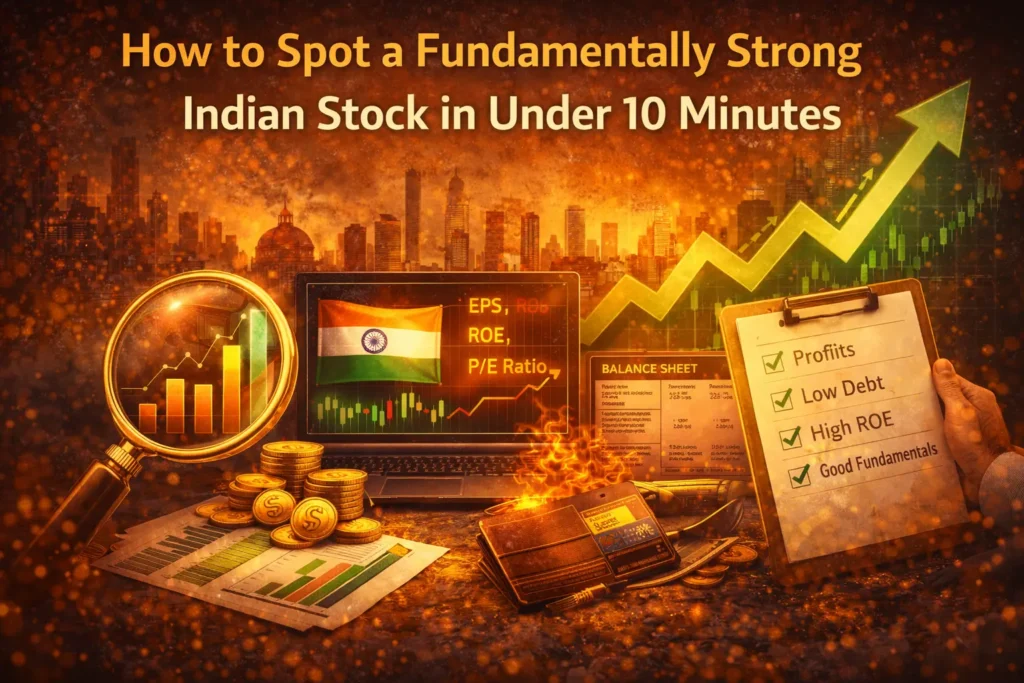
How to Spot a Fundamentally Strong Indian Stock in Under 10 Minutes
Equity Research · Personal Finance | ⏱ ~10 min per stock
The Indian equity market lists over 5,000 companies. Without a repeatable filter, even experienced investors get swept up in tips, momentum, and quarterly noise. Fundamental analysis cuts through it — but only if you have a structured, time-boxed process.
The framework below is designed for a 10-minute first-pass screen. If a stock fails any early step, you stop and move on. If it clears all seven, it earns a deeper look.
The 7-Step Framework at a Glance
| Time | Step | What You Check |
|---|---|---|
| 0:00 | Step 1 | Business quality — can you explain it in one sentence? |
| 1:30 | Step 2 | Revenue and profit — 5-year CAGR test |
| 3:00 | Step 3 | Profitability margins — operating and net |
| 4:30 | Step 4 | Return ratios — ROE and ROCE |
| 6:00 | Step 5 | Debt and balance sheet health |
| 7:30 | Step 6 | Promoter holding and governance signals |
| 9:00 | Step 7 | Valuation sanity check vs. peers |
Step 1 — Is the Business Simple and Defensible? (~90 seconds)
Before touching a single number, ask: can you explain what this company does in one sentence? And can you name at least one reason why customers keep coming back? Companies with unclear business models or no obvious moat rarely sustain earnings growth.
The one-sentence test: Strong businesses pass easily: “Asian Paints manufactures and sells decorative paints across India with the widest distribution network in the sector.” If you are struggling to articulate the business, skip it.
- ✅ Business model is easy to understand
- ✅ Product or service has repeat purchase potential
- ✅ Company operates in a growing sector (FMCG, pharma, infra, IT services)
- ⚠️ Avoid commodity-only businesses unless they have clear scale advantages
Step 2 — Revenue and Profit: The 5-Year CAGR Test (~90 seconds)
Open screener.in and search the company. On the summary page, look at the 5-year compounded sales growth and profit growth figures. These two numbers alone eliminate most poor-quality stocks.
| Metric | Strong ✅ | Acceptable ⚠️ | Reject ❌ |
|---|---|---|---|
| 5-yr Sales CAGR | > 15% | 10–15% | < 10% |
| 5-yr Profit CAGR | > 20% | 12–20% | < 12% |
| Earnings consistency | Positive in 4+ of 5 years | 3 of 5 years | Volatile / declining |
Key Insight: Profit growth must ideally outpace revenue growth. If a company grows revenue at 18% but profits at only 8%, margins are compressing — a red flag worth investigating before proceeding.
Step 3 — Margins: Is the Business Getting More or Less Efficient? (~60 seconds)
Look at the Operating Profit Margin (OPM) trend over five years. A company with stable or expanding margins is a far better business than one whose margins are shrinking even as revenues grow.
| OPM Level | Signal | What It Means |
|---|---|---|
| > 20% | ✅ Excellent | Pricing power and cost discipline both present |
| 12–20% | ⚠️ Acceptable | Sector-dependent; check peers before judging |
| < 8% | ❌ Concern | Low-margin, high-volume — very susceptible to cost shocks |
| Net Profit Margin > 10% | ✅ Healthy | Profitable after tax, interest, and depreciation |
For manufacturing companies, OPM below 10% is a warning sign unless the sector is structurally low-margin (e.g., distribution, trading). For IT services, software, and branded FMCG, expect OPM above 18%.
Step 4 — ROE and ROCE: Does the Business Earn Its Keep? (~60 seconds)
Return on Equity (ROE) and Return on Capital Employed (ROCE) tell you whether management is deploying capital productively. A company can show accounting profits and still be destroying shareholder value if its returns are below the cost of capital.
| Ratio | What It Measures | Target (Indian market) |
|---|---|---|
| ROE | Return on shareholders’ equity | > 15% consistently |
| ROCE | Return on total capital deployed | > 15%, above WACC |
| ROE – ROCE gap | Indicates leverage dependency | Should be narrow (< 5%) |
Watch out for: A very high ROE (say, 40%+) powered by very high debt is misleading. Always cross-check ROE with ROCE. If ROCE is much lower than ROE, the company is borrowing to juice returns — a fragile position when interest rates rise.
Step 5 — Debt and Balance Sheet Health (~90 seconds)
Debt is the single biggest destroyer of otherwise good businesses. A leveraged company has very little margin of safety when revenues slow, interest rates rise, or sector cycles turn. Look for three things on screener.in’s balance sheet tab.
- ✅ Debt-to-Equity below 0.5x — ideally zero-debt or net-cash. For capital-intensive sectors like infra or steel, below 1.5x is acceptable.
- ✅ Interest coverage above 5x — EBIT divided by interest expense. Below 3x means the company is stretched to service debt.
- ✅ Free Cash Flow positive — the company should be generating cash, not just reporting paper profits. Check Cash Flow from Operations minus Capex over three years.
- ⚠️ Rising accounts receivable faster than revenue growth signals possible channel stuffing or collection issues.
- ❌ Reject any company where debt has doubled in the last two years without a clear expansion rationale.
Step 6 — Promoter Holding and Governance Signals (~60 seconds)
In the Indian market, promoter holding is a uniquely powerful signal. When founders and promoters hold a large stake in their own company, incentives are aligned with minority shareholders. The BSE/NSE shareholding pattern, updated quarterly, makes this easy to check.
| Metric | Healthy Range | What to Watch |
|---|---|---|
| Promoter Holding | 50–75% | Below 25% is a concern; high is alignment signal |
| Promoter Pledge % | < 5% | High pledging signals financial stress at promoter level |
| FII + DII Holding | > 20% | Institutional interest validates research coverage |
Governance red flags — stop immediately if you see these: Related-party transactions that are large and unexplained; frequent auditor changes; qualified audit opinions; rapid promoter stake reduction; unusually high salary to promoter relative to company size.
Step 7 — Valuation: Are You Paying a Fair Price? (~90 seconds)
A great business at an outrageous valuation can still be a poor investment. The final check is relative valuation — compare the stock’s multiples against its own 5-year history and against sector peers.
| Multiple | What to Look For | Where to Find It |
|---|---|---|
| P/E Ratio | Below 5-yr median P/E and below sector P/E | screener.in, Moneycontrol |
| PEG Ratio | Below 1.5 (P/E ÷ expected EPS growth) | Calculate manually |
| P/B Ratio | Below 3x for most sectors; below 1.5x for PSUs | screener.in |
| EV/EBITDA | Below 15x for mid/small caps in growth sectors | Moneycontrol, TradingView |
Valuation is not a pass/fail gate — it determines your margin of safety. A stock can be fundamentally strong but temporarily expensive. In that case, it goes on a watchlist, not a buy list.
The 7-Point Fundamental Scorecard
A stock that clears all seven steps earns a high conviction score. Use this as a first filter — not the final word. Deeper due diligence (annual report reading, sector analysis, management commentary) should always follow.
| Score | Verdict | Next Action |
|---|---|---|
| 7/7 pass | ✅ High Conviction | Proceed to deep research — read the last 3 annual reports |
| 5–6/7 pass | ⚠️ Watchlist Candidate | Understand the gaps first; revisit next quarter |
| < 5/7 pass | ❌ Skip for Now | Return only if the fundamental story changes |
One final reminder: Fundamental strength is necessary but not sufficient. Market timing, macro conditions, sector cycles, and liquidity all play a role. This 10-minute framework is your first filter — it finds companies worth the next hour of research, not guaranteed winners.
Useful Tools for This Framework
screener.in · NSE India · Moneycontrol · Tijori Finance · Trendlyne · BSE Shareholding Data
Disclaimer: This article is for educational purposes only. Nothing here constitutes investment advice. Always conduct your own due diligence before making any investment decision.