
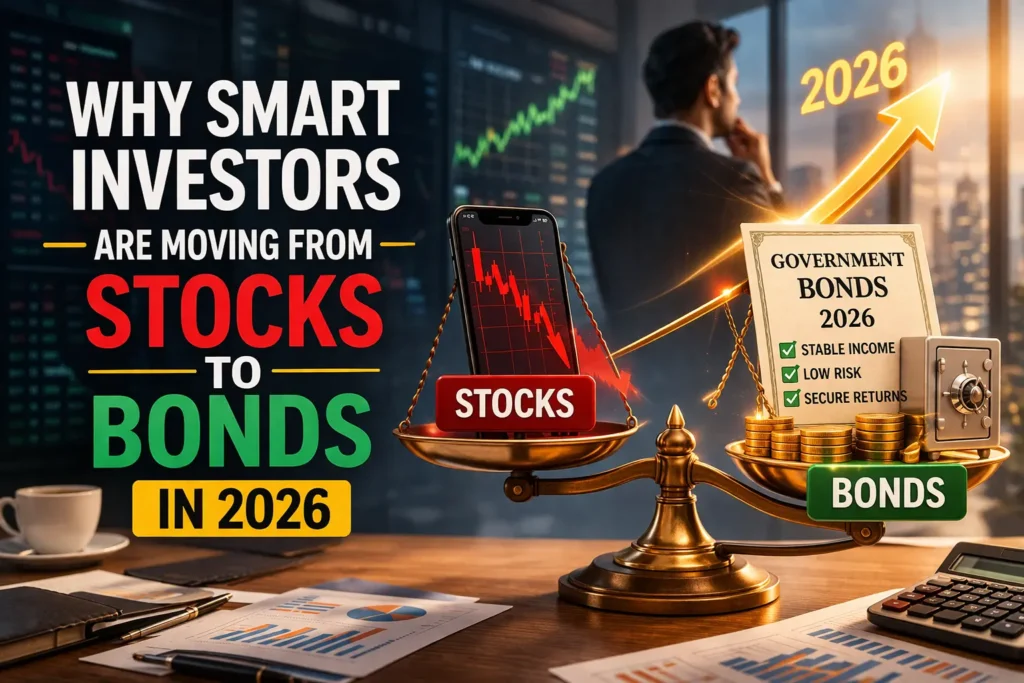
Why Smart Investors Are Moving from Stocks to Bonds in 2026
📊 Introduction
A subtle but important shift is happening in financial markets in 2026. While stock markets continue to attract attention, a growing number of smart investors are quietly increasing their exposure to bonds.
This isn’t panic — it’s strategy. Investors are adjusting their portfolios in response to changing macroeconomic conditions like rising interest rates, inflation pressures, and global uncertainty.
📉 Stock Market Volatility Is Rising
Over the past year, stock markets have delivered strong returns, but with increasing volatility. Sudden corrections, geopolitical tensions, and inflation-related concerns have made equity investments less predictable.
For many investors, especially those who entered the market recently, this volatility has been uncomfortable. The focus is now shifting from aggressive growth to risk-adjusted returns.
💰 Why Bonds Are Becoming Attractive Again
1. Rising Interest Rates Are Boosting Yields
As central banks tighten monetary policy, interest rates have increased. This directly improves bond yields.
For example, government bonds that previously offered 5–6% returns are now offering closer to 7–8% in some cases. This makes them competitive with many traditional investment options.
2. Predictable and Stable Income
Unlike stocks, bonds provide:
- Fixed interest payments
- Defined maturity timelines
- Lower price volatility (in many cases)
This predictability is appealing, especially for investors looking for steady cash flow.
3. Capital Preservation Is Back in Focus
After years of aggressive investing, many investors are now prioritizing wealth protection. Bonds, particularly government-backed securities, are considered one of the safest ways to preserve capital.
🏦 Where Is the Money Going?
Investors are not just buying any bonds — they are strategically allocating funds across:
- Government Securities (G-Secs)
- High-quality corporate bonds
- Tax-free bonds
- Debt mutual funds
This diversification helps balance risk and return.
🤔 Should Retail Investors Follow This Trend?
The answer depends on your financial goals.
If you are:
- Young and growth-focused → stocks should still dominate
- Mid-career → a mix of stocks and bonds is ideal
- Near retirement → higher allocation to bonds makes sense
The key is balance, not replacement.
⚠️ Important Insight
This is not the end of equities. Instead, it marks the beginning of a more disciplined investment approach, where investors combine growth (stocks) with stability (bonds).
🚀 Conclusion
The shift toward bonds in 2026 reflects a smarter and more mature investment strategy.
Instead of chasing quick profits, investors are focusing on consistency, income, and risk management.
For retail investors, this is a valuable lesson:
👉 Long-term success is not just about earning more — it’s about protecting what you earn.